Pisa, 15 January 2026.
The economic impact of the Pisa Marathon, which took place on the city’s streets last 21 December, is estimated at around €2 million. Considering the investment of public resources, this represents a return of approximately €67 for every euro invested.
The average daily expenditure of those present is in fact estimated at €154 for overnight stays (for a total of €1,684,760) and €93 for day visitors’ spending (for a total of €353,400). The overall direct economic impact is therefore estimated at €2,038,160.
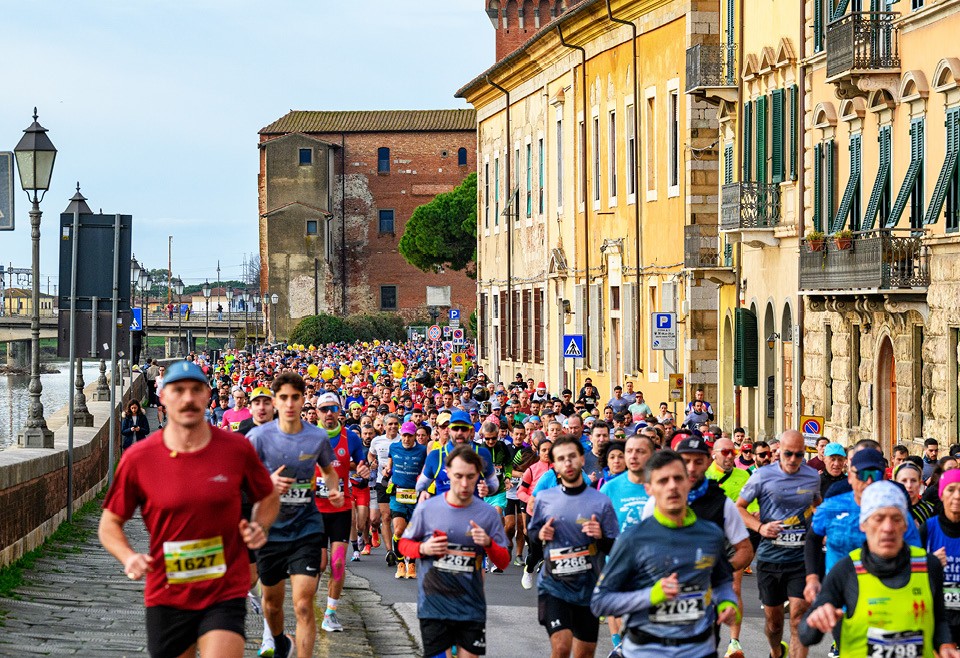
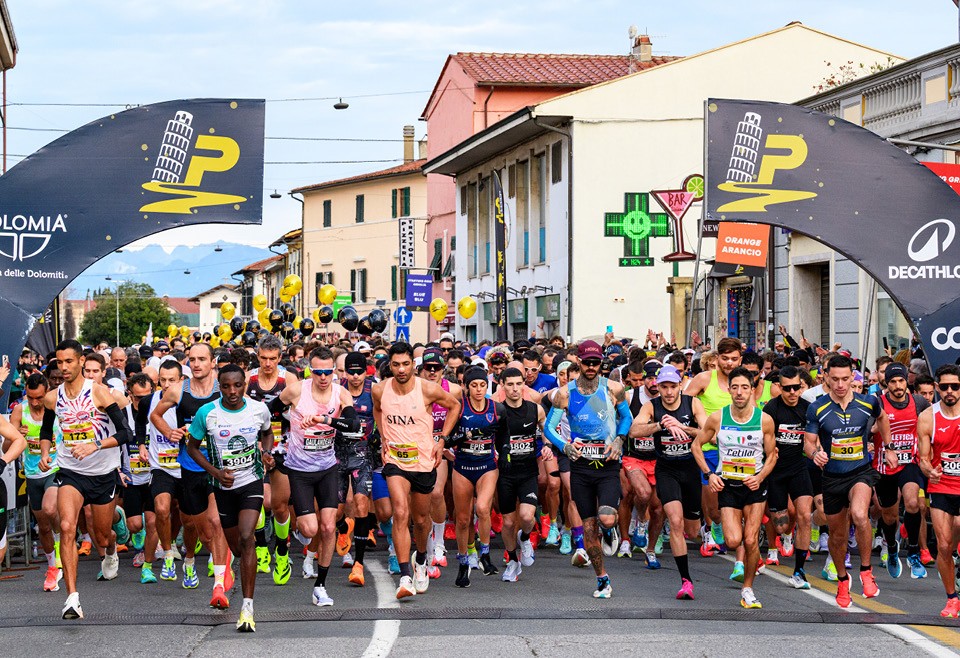
A total of 3,833 athletes started the race, while the overall number of people in the city (including accompanying persons) reached 10,350. Participants came 71.5% from Italy, 5.4% from Great Britain, 4.9% from France, and from other countries such as Germany, Spain, Poland, Hungary, the United States, and Brazil. 6,550 people stayed overnight in Pisa, with an average stay of 1.67 nights, equal to 10,940 tourist overnight stays.
The Marathon is organized by the Municipality of Pisa, SSD 1063AD, and TriO Events. At the presentation of the data on the tourism impact were present Frida Scarpa, Councillor for Sport of the Municipality of Pisa, Alberto Giovannelli, President of Pisamo, Max Rovatti of SSD TriO Events, and Sergio Costanzo of SSD 1063AD.
“We are very satisfied with the figures from the 2025 edition of the marathon,” said Frida Scarpa, Councillor for Sport of the Municipality of Pisa. “More than 10,000 people brought life to our area, generating an economic impact exceeding €2 million. Each athlete brought at least two accompanying persons, staying on average almost two nights in Pisa, confirming how the sport–tourism equation continues to be one of the winning drivers for the economy not only of the city, but of the entire country. These results give citizens a concrete reason to believe in this event and confirm how important it is for relaunching the image and reputation of Pisa at both national and international levels. The marathon fits into a broader framework of successes in Pisan sport and initiatives that the Administration strongly supports, such as Pisa’s promotion to Serie A and many other major sporting events. Many participants stay in Pisa for two or three days and also visit other parts of Italy, with a positive impact on tourism and local commerce. For this reason, it is essential to continue building networks among accommodation facilities, restaurants, museums, and cultural routes, offering increasingly complete and attractive services, so that Pisa becomes the preferred choice among Italian marathons.”
“The marathon,” she continued, “also has significant value in terms of reducing seasonality: it takes place in December, just before the holidays, a traditionally quieter period, and this makes it possible to attract Italian and foreign visitors who often choose Pisa as the first stop of a longer holiday in Italy. For the 2026 marathon, scheduled for next 20 December, we want to further strengthen this sport–tourism combination, aiming to increase registrations to at least 5,000 and to climb the Italian marathon rankings. We will continue to invest in the city’s image, in the quality of the event, and in the participants’ experience, aware of the central role that events of this scale play for Pisa’s economy, tourism, and reputation.”
“We are also working on the course for the next edition of the marathon,” the Councillor concluded, “with the aim of making it even more functional for residents and safer and more spectacular for athletes. In the coming months, we will engage in a participatory process with citizens to assess concrete improvements that make the race more accessible and free from disruptive elements, without compromising the athletes’ experience.”
“As always,” stated Alberto Giovannelli, President of Pisamo, “we have ensured organizational support for complex events such as the Pisa Marathon, the Pisanina, and the Christmas Run on behalf of the municipal administration. The participation and satisfaction data presented increase our satisfaction, because they describe a sporting event appreciated also from an organizational standpoint: the excellent ratings demonstrate that the company has done its part in managing traffic and access. We naturally remain available to work on further improving the course, balancing the needs of sporting events with those of residents, shopkeepers, and the city during a particularly delicate time of year. The positive feedback encourages us to continue along this path, offering an increasingly effective contribution to the Municipality and the organizers.”
“Despite the fact that the reorganization of the organizational structure led to a six-month delay in the opening of registrations,” said Max Rovatti of TriO Events, “we exceeded the total number of registrations from the previous edition, with 4,100 runners, corresponding to 10,350 people in the city between athletes and accompanying persons. By differentiating the average spending of those who stayed overnight and those who were present only for the day, the event generated an impact of €2 million on the area. This is an excellent starting point for a pathway that, in the future, aims to bring the Pisa Marathon into the top 5 Italian 42K races. We are already at work on the 27th edition, scheduled for 20 December, with registration opening set for 20 January.”
“The Pisa Marathon is a fast race that winds through art, history, and unique landscapes. It is the last race of the year on the international federation calendar. All these features exert a strong appeal for athletes from all over the world,” stated Sergio Costanzo of 1063AD, technical director of the event, “but competitions are now chosen (and judged) above all for what host cities are able to offer. The municipal administration has clearly changed pace, but across the various sectors of commerce, hospitality, and the tourism and cultural offer—as well as within the university institutions—there is still much to imagine and implement.”
Qualitative survey among participants
The Marathon organization also carried out a qualitative survey among runners. 658 questionnaires were completed by participants, representing 17.5% of the total, distributed among the marathon (46%), half marathon (47%), and Christmas Run (7%).
The event was described as “well organized, clear and professional, with effective communication before and during the race.” It received a score of 4.36 out of 5 for “Overall organization” and 4.35/5 for “Communication.” High ratings were also recorded for “Staff and volunteers” (4.58/5), “Finish logistics” (4.47/5), “Start logistics” (4.34/5), and “Speaker and pre-/post-race atmosphere” (4.36/5). Participants’ evaluations of the course and race services were also solid, particularly “Race course” (4.01/5) and “Aid stations along the course” (4.03/5). Suggestions for improvement mainly concerned the “Race pack” (3.93/5) and the “Finish refreshments” (3.49/5).
Feedback regarding future editions was also positive. 84.5% of participants said they would recommend the Pisa Marathon to a friend, compared to 4.6% who would not, and 11% who answered “Maybe.” 18.7% stated they would take part again next year, 46.7% were undecided, and 24.6% said no.
Other questions concerned the means of transport used to reach the city: car (66.2%), airplane (14.4%), train (12.9%), and other means (6.5%). Each athlete brought an average of 1.7 accompanying persons, confirming the strong impact of the event not only on athletes but also on families and friends, with direct effects on the local area: alone (14.4%), with 1 person (25.7%), with 2 people (34.3%), with 3 or more people (25.6%). 63.3% stated that they stayed overnight in Pisa: of these, 56% for one night, 20.8% for two nights, and 23.2% for three or more nights. Accommodation choices were mainly hotels (39%), followed by B&Bs (25.8%), apartments (25.1%), and other options (10.1%).